جاري التحميل...
جاري تحميل محتوى الصفحةجاري التحميل...
جاري تحميل محتوى الصفحة
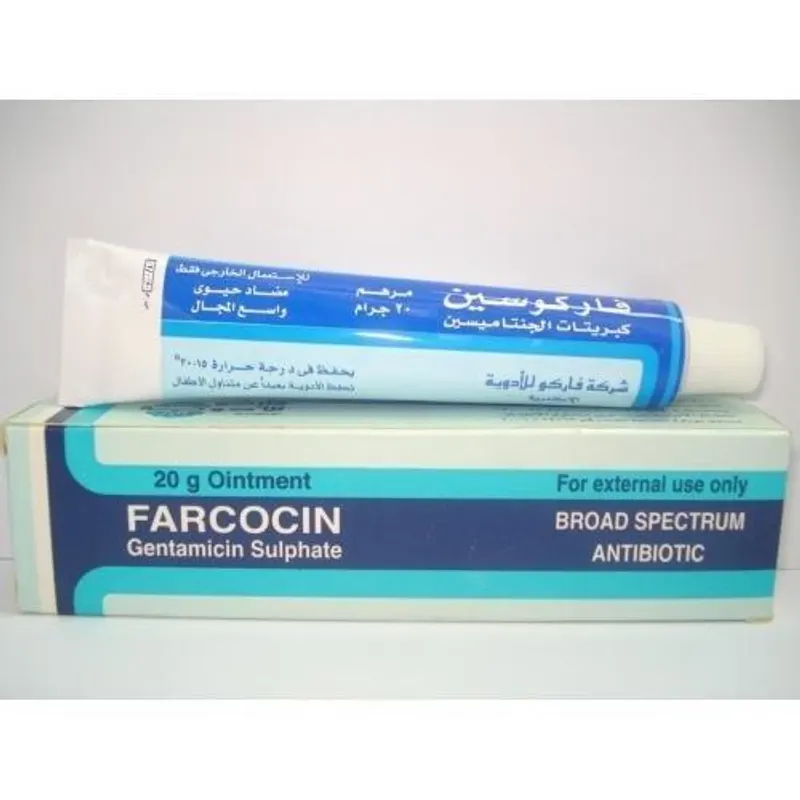
farcocin 0.1% oint. 20 gm
سعر فاركوسين مرهم 20 جرام في صيدلية عبدالخالق وجمال: 23 ج.م.
مضاد حيوي.
Drug Monograph — gentamicin
Farcocin دواء يحتوي على المادة الفعالة gentamicin. المعلومات التالية عن المادة الفعالة للتثقيف الصحي. الجنتاميسين مضاد حيوي من مجموعة الأمينوجليكوزيد فعّال ضد بكتيريا معينة.
يُستخدم بوصفة طبية كحقن لعلاج عدوى بكتيرية متوسطة إلى شديدة، وكقطرة/مرهم لعدوى العين والجلد.
To reduce the development of drug-resistant bacteria and maintain the effectiveness of Gentamicin Injection, USP and other antibacterial drugs, Gentamicin Injection, USP should be used only to treat or prevent infections that are proven or strongly suspected to be caused by susceptible bacteria. When culture and susceptibility information are available, they should be considered in selecting or modifying antibacterial therapy. In the absence of such data, local epidemiology and susceptibility patterns may contribute to the empiric selection of therapy. Gentamicin Injection, USP is indicated in the treatment of serious infections caused by susceptible strains of the following microorganisms: Pseudomonas aeruginosa, Proteus species (indole-positive and indole-negative), Escherichia coli, Klebsiella-Enterobacter-Serratia species, Citrobacter species and Staphylococcus species (coagulase-positive and coagulase-negative). Clinical studies have shown gentamicin injection to be effective in bacterial neonatal sepsis; bacterial septicemia and serious bacterial infections of the central nervous system (meningitis), urinary tract, respiratory tract, gastrointestinal tract (including peritonitis), skin, bone and soft tissue (including burns). Aminoglycosides, including gentamicin, are not indicated in uncomplicated initial episodes of urinary tract infections unless the causative organisms are susceptible to these antibiotics and are not susceptible to antibiotics having less potential for toxicity. Specimens for bacterial culture should be obtained to isolate and identify causative organisms and to determine their susceptibility to gentamicin. Gentamicin injection may be considered as initial therapy in suspected or confirmed gram-negative infections, and therapy may be instituted before obtaining results of susceptibility testing. The decision to continue therapy with this drug should be based on the results of susceptibility tests, the severity of the infection and the important additional concepts contained in the BOXED WARNINGS . If the causative organisms are resistant to gentamicin, other appropriate therapy should be instituted. In serious infections when the causative organisms are unknown, gentamicin injection may be administered as initial therapy in conjunction with a penicillin-type or cephalosporin-type drug before obtaining results of susceptibility testing....
الحقن يُعطى ويُتابَع بواسطة مختص مع مراقبة وظائف الكلى. القطرة/المرهم حسب النشرة أو وصف الطبيب.
Gentamicin injection may be given IM or IV. The patient’s pretreatment body weight should be obtained for calculation of correct dosage. The dosage of aminoglycosides in obese patients should be based on an estimate of the lean body mass. It is desirable to limit the duration of treatment with aminoglycosides to short term. PATIENTS WITH NORMAL RENAL FUNCTION Adults The recommended dosage of gentamicin injection for patients with serious infections and normal renal function is 3 mg/kg/day, administered in three equal doses every eight hours (Table 3) . For patients with life-threatening infections, dosages up to 5 mg/kg/day may be administered in three or four equal doses. This dosage should be reduced to 3 mg/kg/day as soon as clinically indicated (Table 3) . It is desirable to measure both peak and trough serum concentrations of gentamicin to determine the adequacy and safety of the dosage. When such measurements are feasible, they should be carried out periodically during therapy to assure adequate but not excessive drug levels. For example, the peak concentration (at 30 to 60 minutes after IM injection) is expected to be in the range of 4 to 6 mcg/mL. When monitoring peak concentrations after IM or IV administration, dosage should be adjusted so that prolonged levels above 12 mcg/mL are avoided. When monitoring trough concentrations (just prior to the next dose), dosage should be adjusted so that levels above 2 mcg/mL are avoided. Determination of the adequacy of a serum level for a particular patient must take into consideration the susceptibility of the causative organism, the severity of the infection and the status of the patient’s host-defense mechanisms. In patients with extensive burns, altered pharmacokinetics may result in reduced serum concentrations of aminoglycosides. In such patients treated with gentamicin, measurement of serum concentrations is recommended as a basis for dosage adjustment. TABLE 3 DOSAGE SCHEDULE GUIDE FOR ADULTS WITH NORMAL RENAL FUNCTION (Dosage at Eight-Hour Intervals) 40 mg per mL Patient’s Weight* Usual Dose for Serious Infections 1 mg/kg q8h (3 mg/kg/day) Dose for Life-Threatening Infections (Reduce As Soon As Clinically Indicated) 1.7 mg/kg q8h** (5 mg/kg/day) kg (lb) mg/dose mL/dose mg/dose mL/dose q8h q8h 40 ( 88 ) 40 1 66 1.6 45 ( 99) 45 1.1 75 1.9 50 (110) 50 1.25 83 2.1 55 (121) 55 1.4 91 2.25 60 (132) 60 1.5 100 2.5 65 (143) 65 1.6 108 2.7 70 (154) 70 1.75 116 2.9 75 (165) 75 1.9 125 3.1 80 (176) 80 2 133 3....
الحقن قد يؤثر على الكلى والسمع والتوازن مع الجرعات العالية أو المطوّلة؛ القطرة قد تسبب تهيجاً موضعياً عابراً.
To report SUSPECTED , contact Fresenius Kabi USA, LLC at 1-800-551-7176 or FDA at 1-800-FDA-1088 or www.fda.gov/medwatch. Nephrotoxicity Adverse renal effects, as demonstrated by the presence of casts, cells or protein in the urine or by rising BUN, NPN, serum creatinine or oliguria, have been reported. They occur more frequently in patients with a history of renal impairment (especially if dialysis is required) and in patients treated for longer periods or with larger doses than recommended. Neurotoxicity Serious adverse effects on both vestibular and auditory branches of the eighth nerve have been reported, primarily in patients with renal impairment (especially if hemodialysis is required) and in patients on high doses and/or prolonged therapy. Symptoms include dizziness, vertigo, tinnitus, roaring in the ears and also hearing loss, which, as with the other aminoglycosides, may be irreversible. Hearing loss is usually manifested initially by diminution of high-tone acuity. Other factors which may increase the risk of toxicity include excessive dosage, dehydration and previous exposure to other ototoxic drugs. Peripheral neuropathy or encephalopathy, including numbness, skin tingling, muscle twitching, convulsions and a myasthenia gravis-like syndrome have been reported. NOTE: The risk of toxic reactions is low in patients with normal renal function who did not receive gentamicin sulfate at higher doses or for longer periods of time than recommended. Other reported possibly related to gentamicin include: respiratory depression, lethargy, confusion, depression, visual disturbances, decreased appetite, weight loss and hypotension and hypertension; rash, itching, urticaria, generalized burning, laryngeal edema, anaphylactoid reactions, fever and headache; nausea, vomiting, increased salivation and stomatitis; purpura, pseudotumor cerebri, acute organic brain syndrome, pulmonary fibrosis, alopecia, joint pain, transient hepatomegaly and splenomegaly. Laboratory abnormalities possibly related to gentamicin include: increased levels of serum transaminase (SGOT, SGPT), serum LDH and bilirubin; decreased serum calcium, magnesium, sodium and potassium; anemia, leukopenia, granulocytopenia, transient agranulocytosis, eosinophilia, increased and decreased reticulocyte counts and thrombocytopenia. While clinical laboratory test abnormalities may be isolated findings, they may also be associated with clinically related signs and symptoms....
يُستخدم بحذر شديد مع أمراض الكلى والسمع؛ لا يُستخدم مع حساسية الأمينوجليكوزيد.
Hypersensitivity to gentamicin is a contraindication to its use. A history of hypersensitivity or serious toxic reactions to other aminoglycosides may contraindicate use of gentamicin because of the known cross-sensitivity of patients to drugs in this class.
Farcocin متوفر في شكل مرهم بتركيز 0.1%/20GM.
يُحفظ حسب النشرة بعيداً عن متناول الأطفال.
هذه المعلومات الدوائية للتثقيف الصحي العام فقط، ولا تُغني عن استشارة الصيدلي أو الطبيب المختص. لا تبدأ أو توقف أو تغيّر جرعة أي دواء بدون إشراف طبي.
00 · Empty
لا توجد تقييمات معتمدة لهذا المنتج بعد. كن أول من يقيّم!