جاري التحميل...
جاري تحميل محتوى الصفحةجاري التحميل...
جاري تحميل محتوى الصفحة
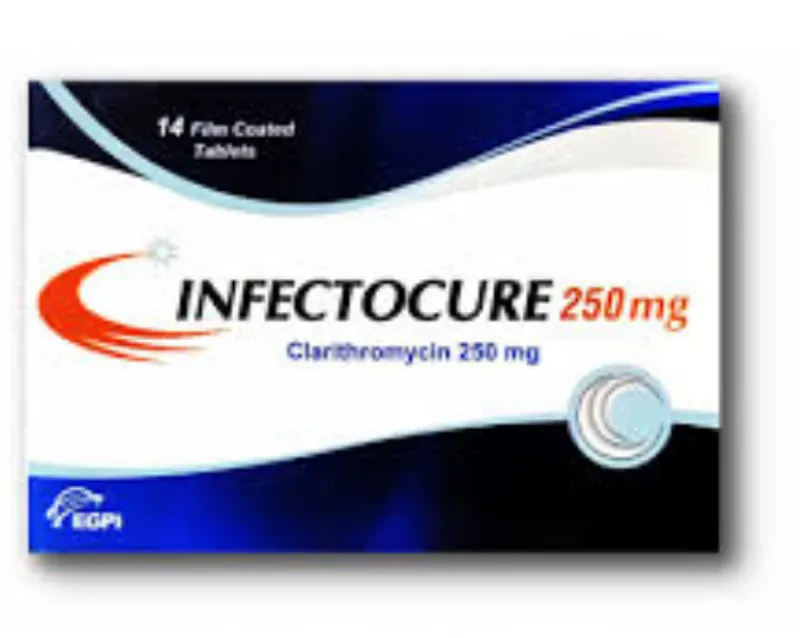
infectocure 250 mg 14 f.c.tabs
سعر انفكتوكيور 250مجم 14 قرص في صيدلية عبدالخالق وجمال: 91 ج.م.
مضاد حيوي
Drug Monograph — clarithromycin
Infectocure دواء يحتوي على المادة الفعالة clarithromycin. المعلومات التالية عن المادة الفعالة للتثقيف الصحي. الكلاريثرومايسين مضاد حيوي من مجموعة الماكروليد.
12.1 Mechanism of Action Clarithromycin is a macrolide antimicrobial drug [see Microbiology ( 12.4 )] .
يُستخدم بوصفة طبية لعلاج عدوى الجهاز التنفسي والجلد، وكجزء من علاج جرثومة المعدة.
Clarithromycin is a macrolide antimicrobial indicated for mild to moderate infections caused by designated, susceptible bacteria in the following: Acute Bacterial Exacerbation of Chronic Bronchitis in Adults ( 1.1 ) Acute Maxillary Sinusitis ( 1.2 ) Community-Acquired Pneumonia ( 1.3 ) Pharyngitis/Tonsillitis ( 1.4 ) Uncomplicated Skin and Skin Structure Infections ( 1.5 ) Acute Otitis Media in Pediatric Patients ( 1.6 ) Treatment and Prophylaxis of Disseminated Mycobacterial Infections ( 1.7 ) Helicobacter pylori Infection and Duodenal Ulcer Disease in Adults ( 1.8 ) Limitations of Use To reduce the development of drug-resistant bacteria and maintain the effectiveness of clarithromycin tablets and other antibacterial drugs, clarithromycin tablets should be used only to treat or prevent infections that are proven or strongly suspected to be caused by bacteria. ( 1.9 ) 1.1 Acute Bacterial Exacerbation of Chronic Bronchitis Clarithromycin tablets are indicated in adults for the treatment of mild to moderate infections caused by susceptible isolates due to Haemophilus influenzae , Haemophilus parainfluenzae , Moraxella catarrhalis , or Streptococcus pneumoniae [see ( 1.9 )] . 1.2 Acute Maxillary Sinusitis Clarithromycin tablets are indicated for the treatment of mild to moderate infections caused by susceptible isolates due to Haemophilus influenzae , Moraxella catarrhalis , or Streptococcus pneumoniae [see ( 1.9 )] . 1.3 Community-Acquired Pneumonia Clarithromycin tablets are indicated [see ( 1.9 )] for the treatment of mild to moderate infections caused by susceptible isolates due to: Haemophilus influenzae (in adults) Mycoplasma pneumoniae, Streptococcus pneumoniae, Chlamydophila pneumoniae (in adults and pediatric patients) 1.4 Pharyngitis/Tonsillitis Clarithromycin tablets are indicated for the treatment of mild to moderate infections caused by susceptible isolates due to Streptococcus pyogenes as an alternative in individuals who cannot use first line therapy. 1.5 Uncomplicated Skin and Skin Structure Infections Clarithromycin tablets are indicated for the treatment of mild to moderate infections caused by susceptible isolates due to Staphylococcus aureus , or S treptococcus pyogenes . 1.6 Acute Otitis Media Clarithromycin tablets are indicated in pediatric patients for the treatment of mild to moderate infections caused by susceptible isolates due to Haemophilus influenzae , Moraxella catarrhalis , or Streptococcus pneumoniae [see Clinical Studies ( 14....
دواء بوصفة: الجرعة والمدة يحددهما الطبيب — أكمل الكورس كاملاً.
Adults : clarithromycin tablets 250 mg or 500 mg every 12 hours for 7 to 14 days ( 2.2 ) H. pylori eradication (in combination with lansoprazole/amoxicillin, omeprazole/amoxicillin, or omeprazole): clarithromycin tablets 500 mg every 8 or 12 hours for 10 to 14 days. See full prescribing information (FPI) for additional information. ( 2.3 ) Pediatric Patients : clarithromycin 15 mg/kg/day divided every 12 hours for 10 days ( 2.4 ) Mycobacterial Infections : clarithromycin tablets 500 mg every 12 hours; clarithromycin tablets 7.5 mg/kg up to 500 mg every 12 hours in pediatric patients ( 2.5 ) Reduce dose in moderate renal impairment with concomitant atazanavir or ritonavir-containing regimens and in severe renal impairment ( 2.6 ) 2.1 Important Administration Instructions Clarithromycin tablets may be given with or without food. 2.2 Adult Dosage The recommended dosages of clarithromycin tablets for the treatment of mild to moderate infections in adults are listed in Table 1 . Table 1. Adult Dosage Guidelines Infection Clarithromycin Tablets Dosage (every 12 hours) Duration (days) Acute bacterial exacerbation of chronic bronchitis 250 to 500 mg 7 † -14 Acute maxillary sinusitis 500 mg 14 Community-acquired pneumonia 250 mg 7 ǂ -14 Pharyngitis/Tonsillitis 250 mg 10 Uncomplicated skin and skin structure infections 250 mg 7-14 Treatment and prophylaxis of disseminated Mycobacterium avium disease [see ( 2.5 )] 500 mg § - H.pylori eradication to reduce the risk of duodenal ulcer recurrence with amoxicillin and omeprazole or lansoprazole [see ( 2.3 )] 500 mg 10-14 H.pylori eradication to reduce the risk of duodenal ulcer recurrence with omeprazole [see ( 2.3 )] 500 mg every 8 hours 14 * For M. catarrhalis and S. pneumoniae use 250 mg. For H. influenzae and H. parainfluenzae , use 500 mg. † For H parainfluenzae , the duration of therapy is 7 days. ǂ For H. influenzae , the duration of therapy is 7 days. § Clarithromycin therapy should continue if clinical response is observed. Clarithromycin can be discontinued when the patient is considered at low risk of disseminated infection. 2.3 Combination Dosing Regimens for H. pylori Infection Triple therapy: clarithromycin/lansoprazole/amoxicillin The recommended adult dosage is 500 mg clarithromycin tablets, 30 mg lansoprazole, and 1 gram amoxicillin, all given every 12 hours for 10 or 14 days [see ( 1.8 ) and Clinical Studies ( 14.3 )] ....
قد يسبب غثياناً وإسهالاً وتغيّر حاسة التذوق وألم بطن؛ نادراً تأثيراً على نظم القلب.
The following serious are described below and elsewhere in the labeling: Acute Hypersensitivity Reactions [see ( 5.1 )] QT Prolongation [see ( 5.2 )] Hepatotoxicity [see ( 5.3 )] Serious Due to Concomitant Use with Other Drugs [see ( 5.4 )] Clostridium difficile Associated Diarrhea [see ( 5.6 )] Exacerbation of Myasthenia Gravis [see ( 5.8 )] Most frequent for both adult and pediatric populations in clinical trials: abdominal pain, diarrhea, nausea, vomiting, dysgeusia ( 6.1 ) To report SUSPECTED , contact Sandoz Inc. at 1-800-525-8747 or FDA at 1-800-FDA-1088 or www.fda.gov/medwatch. 6.1 Clinical Trials Experience Because clinical studies are conducted under widely varying conditions, adverse reaction rates observed in the clinical studies of a drug cannot be directly compared to rates in the clinical studies of another drug and may not reflect the rates observed in practice. Based on pooled data across all indications, the most frequent for both adult and pediatric populations observed in clinical trials are abdominal pain, diarrhea, nausea, vomiting and dysgeusia. Also reported were dyspepsia, liver function test abnormal, anaphylactic reaction, candidiasis, headache, insomnia, and rash. The subsequent subsections list the most common for prophylaxis and treatment of mycobacterial infections and duodenal ulcer associated with H. pylori infection. In general, these profiles are consistent with the pooled data described above. Prophylaxis of Mycobacterial Infections In AIDS patients treated with clarithromycin over long periods of time for prophylaxis against M. avium , it was often difficult to distinguish possibly associated with clarithromycin administration from underlying HIV disease or intercurrent illness. Median duration of treatment was 10.6 months for the clarithromycin group and 8.2 months for the placebo group. Table 4. Incidence Rates (%) of Selected Includes those events possibly or probably related to study drug and excludes concurrent conditions in Immunocompromised Adult Patients Receiving Prophylaxis Against M. avium Complex Body System 2% or greater Adverse Reaction Incidence Rates for either treatment group Adverse Reaction Clarithromycin (n=339) % Placebo (n=339) % Body as a Whole Abdominal pain 5% 4% Headache 3% 1% Digestive Diarrhea 8% 4% Dyspepsia 4% 3% Flatulence 2% 1% Nausea 11% 7% Vomiting 6% 3% Skin & Appendages Rash 3% 4% Special Senses Taste Perversion 8% Significant higher incidence compared to the placebo-treated group 0....
لا يُستخدم مع حساسية الماكروليدات أو مع أدوية معينة تتعارض معه أو إطالة QT — أخبر الطبيب بكل أدويتك.
Hypersensitivity to clarithromycin or any macrolide drug ( 4.1 ) Cisapride and pimozide ( 4.2 ) History of cholestatic jaundice/hepatic dysfunction with use of clarithromycin ( 4.3 ) Colchicine in renal or hepatic impairment ( 4.4 ) Lomitapide, lovastatin, and simvastatin ( 4.5 ) Ergot alkaloids (ergotamine or dihydroergotamine) ( 4.6 ) Lurasidone ( 4.7 ) 4.1 Hypersensitivity Clarithromycin tablets are contraindicated in patients with a known hypersensitivity to clarithromycin, erythromycin, or any of the macrolide antibacterial drugs [see ( 5.1 )] . 4.2 Cisapride and Pimozide Concomitant administration of clarithromycin tablets with cisapride and pimozide is contraindicated [see ( 7 )] . There have been postmarketing reports of when clarithromycin is co‑administered with cisapride or pimozide, resulting in cardiac arrhythmias (QT prolongation, ventricular tachycardia, ventricular fibrillation, and torsades de pointes ) most likely due to inhibition of metabolism of these drugs by clarithromycin tablets. Fatalities have been reported. 4.3 Cholestatic Jaundice/Hepatic Dysfunction Clarithromycin tablets are contraindicated in patients with a history of cholestatic jaundice or hepatic dysfunction associated with prior use of clarithromycin. 4.4 Colchicine Concomitant administration of clarithromycin tablets and colchicine is contraindicated in patients with renal or hepatic impairment. 4.5 Lomitapide, Lovastatin, and Simvastatin Concomitant administration of clarithromycin tablets with lomitapide is contraindicated due to potential for markedly increased transaminases [see ( 5.4 ) and ( 7 )]. Concomitant administration of clarithromycin tablets with HMG-CoA reductase inhibitors (statins) that are extensively metabolized by CYP3A4 (lovastatin or simvastatin) is contraindicated, due to the increased risk of myopathy, including rhabdomyolysis [see ( 5.4 ) and ( 7 )]. 4.6 Ergot Alkaloids Concomitant administration of clarithromycin and ergotamine or dihydroergotamine is contraindicated [see ( 7 )] . 4.7 Lurasidone Concomitant administration of clarithromycin and lurasidone is contraindicated since it may result in an increase in lurasidone exposure and the potential for serious [see ( 7 ) ]. 4.8 for Co-administered Drugs For information about of other drugs indicated in combination with clarithromycin tablets, refer to their full prescribing information ( section).
Infectocure متوفر في شكل أقراص بتركيز 250MG. العبوة تحتوي على 14 قرص.
يُحفظ في درجة حرارة الغرفة؛ الشراب المحضّر يُحفظ حسب النشرة.
هذه المعلومات الدوائية للتثقيف الصحي العام فقط، ولا تُغني عن استشارة الصيدلي أو الطبيب المختص. لا تبدأ أو توقف أو تغيّر جرعة أي دواء بدون إشراف طبي.
00 · Empty
لا توجد تقييمات معتمدة لهذا المنتج بعد. كن أول من يقيّم!